
Find out more about the study visit, including the country briefs and other resources.
Read the outcomes and learnings from the Brazil study visit.
Watch the recording of the Zoom workshop “UN-Nutrition & Healthy Diets Coalition Workshop on Brazil Study Trip Learnings,” hosted on 29 January 2026.
Strengthening nutrition leadership and action through peer exchange
Insights from the Brazil study visit
Around the world, malnutrition is no longer just about hunger. Countries today face a triple challenge: undernutrition, micronutrient deficiencies, and a rapid rise in obesity and other diet-related noncommunicable diseases (NCDs). These crises hit hardest where systems are weakest – and where intersectoral coordination and operational linkages, including between health, agriculture, education, social protection and climate, are fragile.
In September 2025, ten senior policy leaders[1] from countries across Africa and Asia travelled to Brazil to learn from a country that has turned intersectoral governance into a powerful tool against hunger and all forms of malnutrition. What they brought back was more than inspiration: it was a roadmap for change.
Organized by UN-Nutrition and the Healthy Diets from Sustainable Food Systems Coalition (HDSFS)[2], the study visit fostered peer-to-peer exchange between participants and Brazilian counterparts – from high-level policy dialogue in Brasília, including participation in the Second Global Summit of the School Meals Coalition, to hands-on learning in schools and farming communities.
Below, some of the participants in the visit reflect on how the Brazil experience sparked action for real, tangible change in their own countries.
Voices for real change
DRC – Strengthening legislation for lasting nutrition action
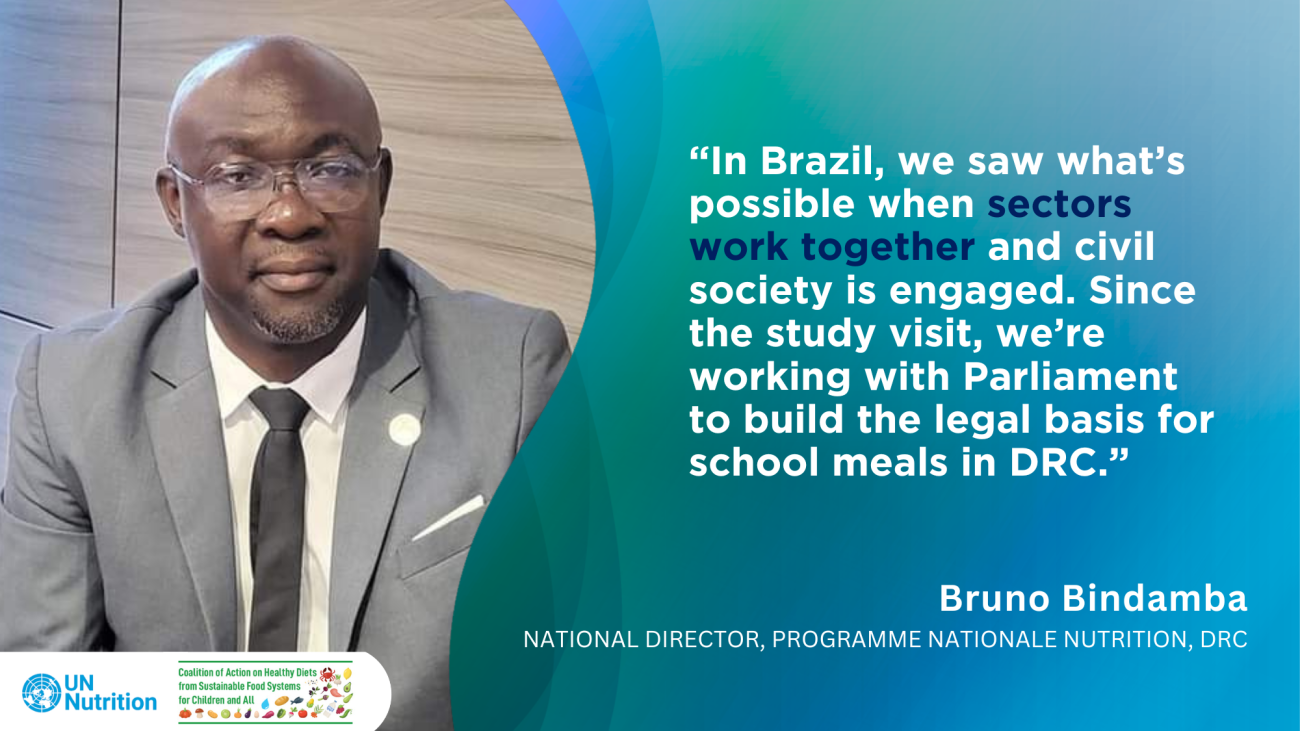
For Bruno Bindamba, National Director of the Programme Nationale de Nutrition of the Democratic Republic of Congo (DRC), the Brazil study visit reinforced a clear message: lasting nutrition progress requires strong political leadership and coordination across government.
DRC has made important gains in recent years in maternal, infant and young child nutrition – including improved exclusive breastfeeding rates. Yet poverty, conflict and food insecurity continue to challenge efforts to scale impact. In Brazil, Dr. Bindamba saw how multisectoral coordination, backed by legislation and domestic financing, can turn policy commitments into lasting impact.
Back home, he shared these learnings with the Ministry of Health and the Scaling up Nutrition (SUN) Movement Committee, bringing 15 ministries into the conversation. As a result, a group of parliamentarians has now been formed to develop a national law on school canteens — an important step toward greater accountability and scale.
PAKISTAN – Connecting school meals, healthy diets, and nutrition governance
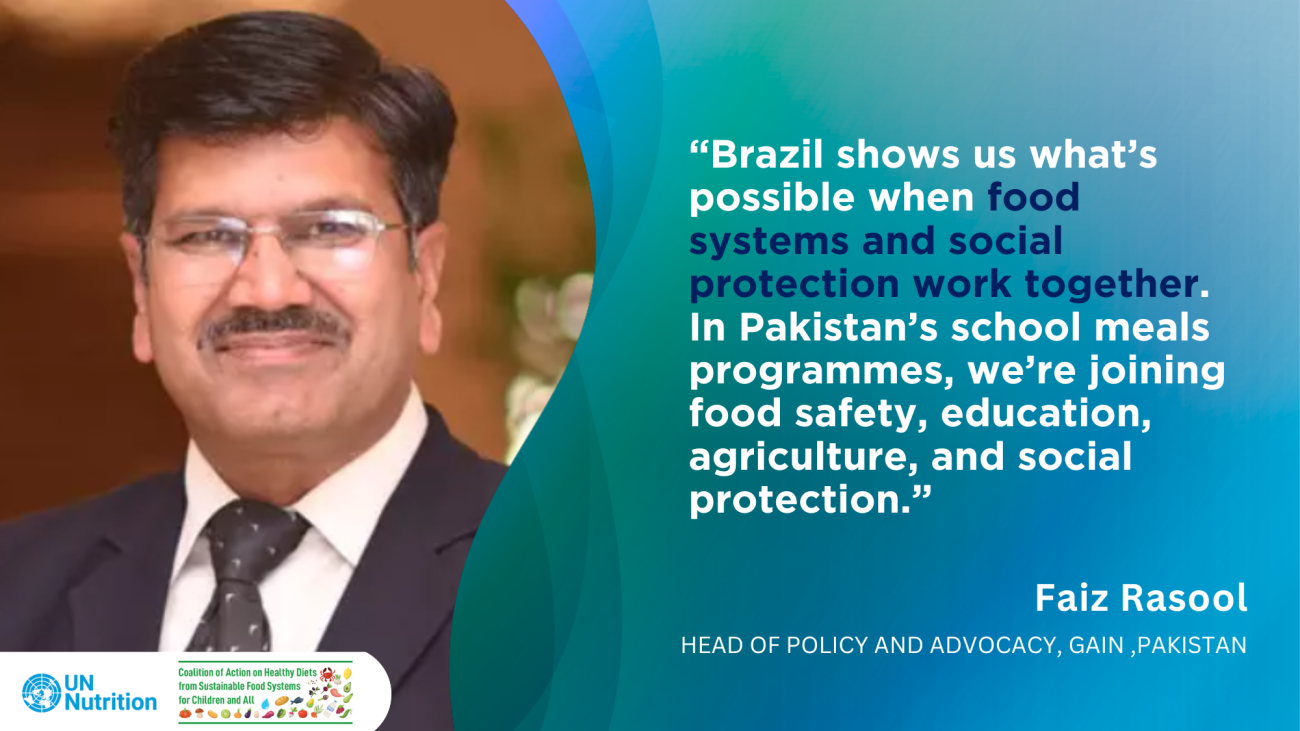
For Faiz Rasool, Head of Policy and Advocacy at the Global Alliance for Improved Nutrition (GAIN) Pakistan (whose participation in the study visit was strongly endorsed by the Government of Pakistan), the Brazil visit strengthened a critical insight: Pakistan should make nutrition everyone’s business – not just the health sector’s.
With over 40% of children affected by stunting and more than 60% of the population unable to afford healthy diets, Pakistan faces a complex nutrition challenge. In Brazil, Mr. Rasool confirmed that access to healthy diets depends on interconnected systems – creating strong linkages between food safety, social protection, education, and agriculture – rather than isolated programmes.
Since the visit, Pakistan fast-tracked the development of comprehensive School Meal Guidelines in Punjab, embedding nutrition, food safety, and sustainability into a single framework and laying the foundation for national scale-up. Work is also underway to establish a Healthy Diets Resource Centre – a cross-sector coordination and learning hub bringing together health, food safety, education, agriculture, and social protection actors.
SIERRA LEONE – Scaling nutrition through political leadership
For Nenebah Jalloh from the Office of the Vice-president of Sierra Leone, acting as National Coordinator for the SUN Movement, the Brazil study visit made it clear that nutrition progress depends on visible political leadership, national ownerships, and coordination beyond the health sector.
Sierra Leone has made strides in improving maternal, infant and young child nutrition, including reduced stunting and higher breastfeeding rates. Still, challenges remain, from high anemia to rising obesity. For Nenebah, Brazil’s example highlighted the power of intersectoral approaches linking home-grown school feeding, cash transfers, and nutrition literacy programs to strengthen food systems and improve diets at scale.
Following the visit, Sierra Leone plans to convene a national debrief with government officials from different sectors and SUN stakeholders, advocating for stronger political leadership and deeper cross-ministerial collaboration to align food systems and nutrition actions.
ZAMBIA – Aligning policy and partnerships for healthier food systems
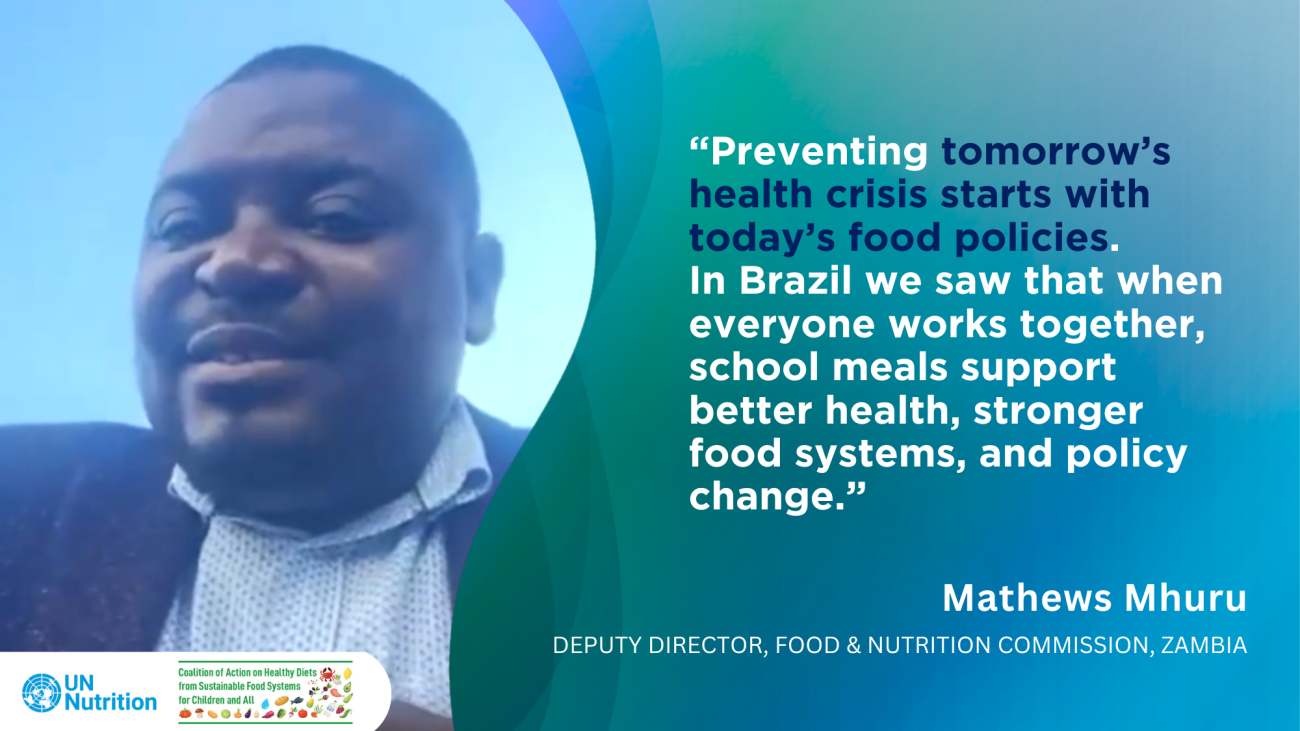
For Mathews Mhuru, Deputy Director of Zambia’s National Food and Nutrition Commission, the biggest lesson from Brazil was that change moves faster when it is championed from the very top.
Inspired by Brazil’s whole-of-government approach, Zambia is now integrating lessons from the study visit into the draft National Food and Nutrition Security Policy. For the first time, the policy addresses not only undernutrition, but also obesity and diet-related diseases – a shift that reflects what participants saw in Brazil, recognizing that today’s food choices shape tomorrow’s health outcomes.
Brazil’s school feeding model stood out as a powerful example of coordination in action, including among government, UN agencies, municipalities, and family farmers. Attention to food quality, diversity, and even portion size offered practical lessons for tackling overweight and obesity.
Since returning, Zambia has deepened dialogue across education, agriculture, and nutrition sectors – aligning roles, data, and targets to transform how healthy school meals are delivered nationwide.
ZIMBABWE – Strengthening coordination and partnerships for nutrition impact
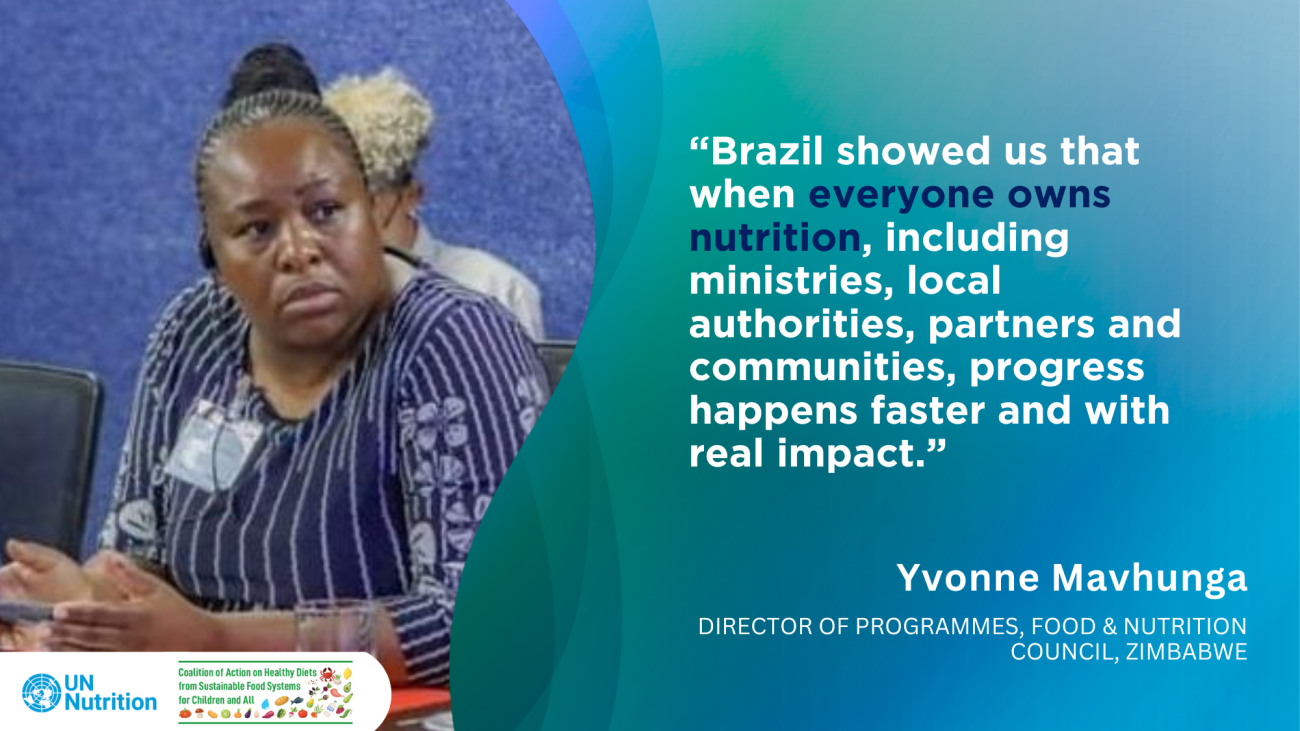
For Yvonne Mavhunga, Director of Programmes at the Food and Nutrition Council of Zimbabwe, the Brazil visit revealed how progress in nutrition accelerates when everyone works together – from the national level all the way to communities.
Inspired by Brazil’s model, Zimbabwe’s Ministry of Primary and Secondary Education and the SUN Secretariat revamped the operationalization of nutrition and health initiatives including nutrition sensitive school feeding, nutrition screening, better school food environments and physical activity under one shared vision. Multiple ministries, including for food systems, have strengthened collaborations, adopting an intersectoral approach and being backed by political will and legislation.
From study visit to sustained change
The Brazil study visit was more than a learning tour. It became a catalyst for new partnerships, new policies and new ambition across countries. One thing became clear: when countries begin a dialogue with each other, their common experiences and challenges arise, building deeper understanding for faster and more sustainable change.
As all participating countries start to turn insights into action, the legacy of the Brazil visit will be measured in how lessons are turned into practical policies that change real lives – supporting healthier populations, stronger food systems and more resilient communities.
----------------------------------------------------------------------------------------------------
[1] Participants were identified through a collaboration between UN-Nutrition, HDSFS Coalition Secretariat, and the Scaling Up Nutrition (SUN) Movement Secretariat. They included SUN Movement focal points and representatives from WHO, among others. Priority was given to countries that have been receiving support from UN-Nutrition through its partnership with Irish Aid. Countries were also selected based on their active engagement in both the HDSFS Coalition and/or the SUN Movement, ensuring alignment with ongoing national efforts to strengthen nutrition policy frameworks and governance mechanisms. One participant from each of the following countries participated in the visit: Burundi, Cambodia, the Democratic Republic of Congo, Liberia, Madagascar, Niger, Pakistan, Sierra Leone, Zambia and Zimbabwe.
[2] Irish Aid financially supported the organization of the study visit through its ongoing partnership with UN-Nutrition on the project “Strengthening the UN-Nutrition country mechanism towards delivering as one.”