
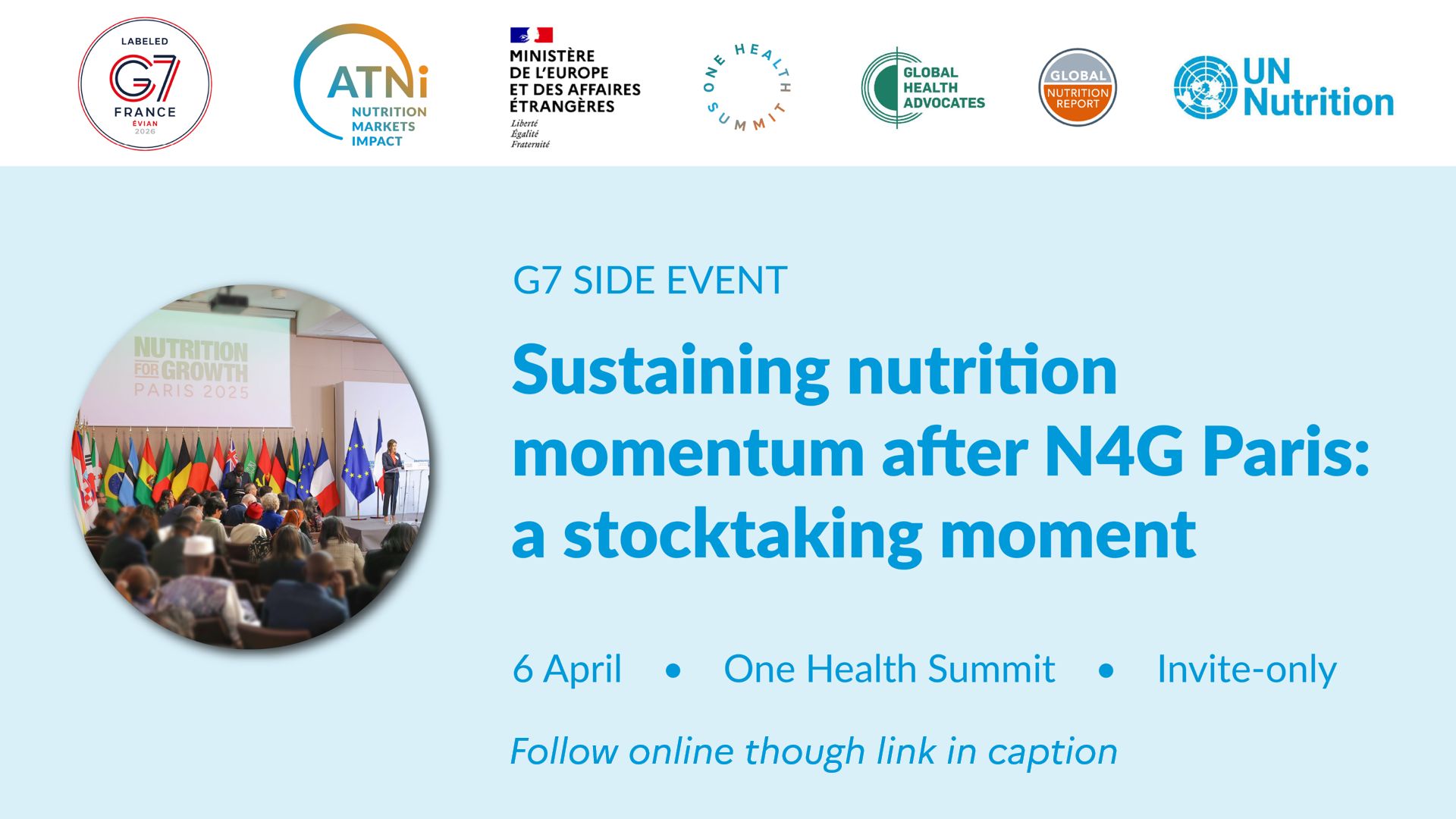
On 6 April 2026, partners gathered in Lyon for the “Post-N4G G7 Side Event: Sustaining nutrition momentum after N4G Paris – Stock-taking moment.” The event was organized by the Ministry for Europe and Foreign Affairs of France and the Access to Nutrition Initiative, in partnership with Global Health Advocates and UN-Nutrition.
Bringing together governments, civil society, researchers, development finance institutions, youth representatives and private sector actors, the event provided an opportunity to reflect on recent progress in nutrition, discuss perspectives for the period following the Nutrition for Growth Summit, and explore ways to sustain global momentum and strengthen commitments to nutrition.
One year after N4G Paris
The gathering took place one year after the landmark Nutrition for Growth Paris 2025 Summit, where more than 600 commitments were made and over USD 30 billion pledged to accelerate global action on nutrition.
Against this backdrop, the Lyon event served as a timely moment to ask two key questions: what has changed since N4G Paris, and how can momentum on nutrition financing and accountability be sustained?
The evening opened with reflections on the commitments made in Paris and a deeper look at progress in countries participating in the Scaling Up Nutrition Movement (SUN), highlighting both achievements and the continued challenges faced by governments and partners working to improve nutrition outcomes.
A call for renewed commitment
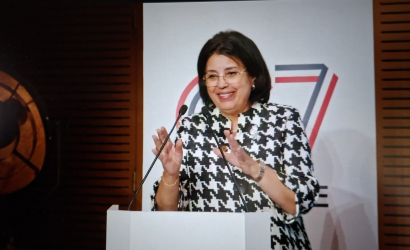
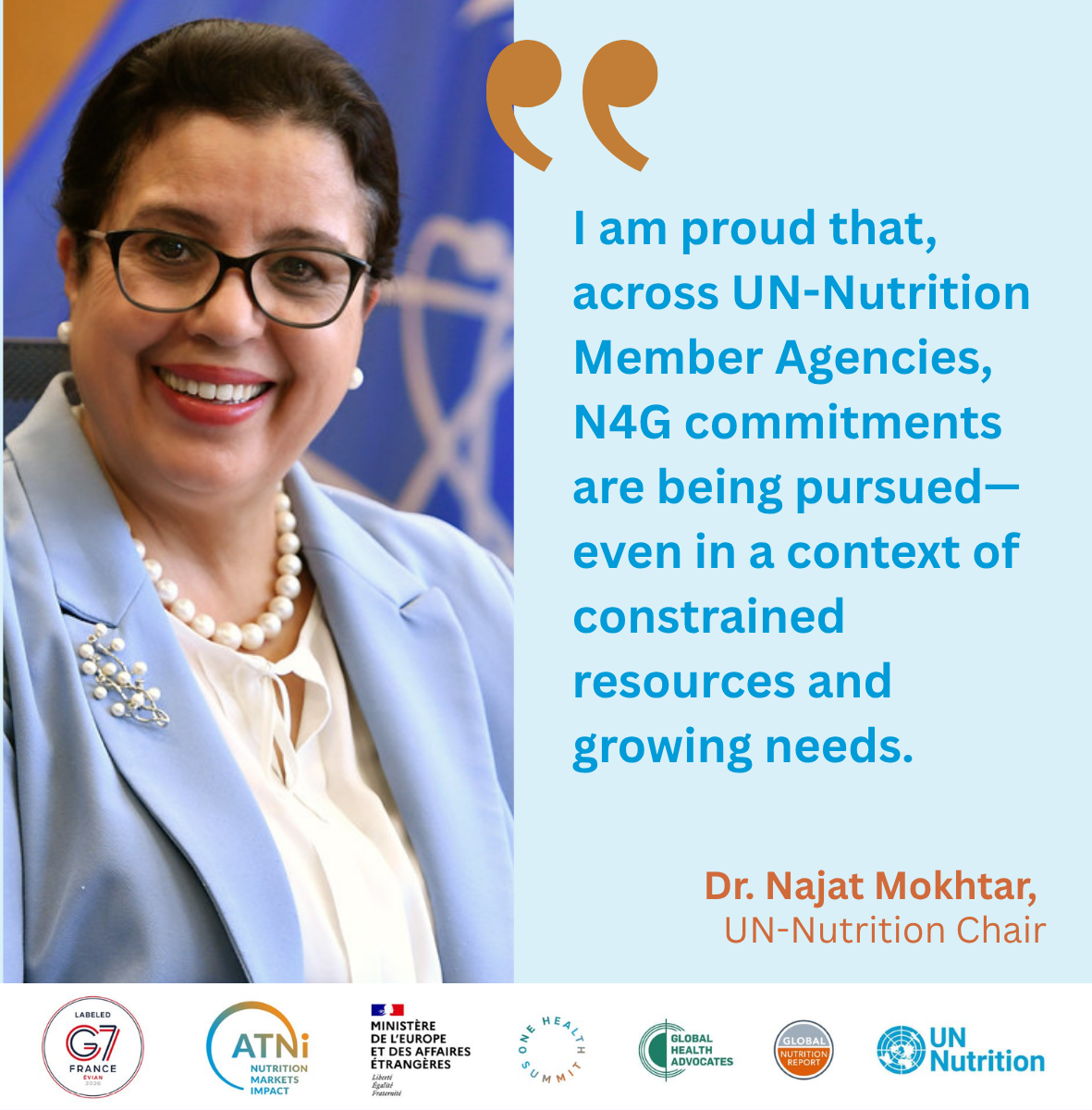
Opening the event, Dr. Najat Mokhtar, Chair of UN-Nutrition, emphasized that the moment called not only for reflection but for renewed determination.
Speaking on behalf of the 15 UN agencies that make up UN-Nutrition, she highlighted the importance of maintaining focus on nutrition despite a challenging global context marked by climate change, conflict, fragility and growing inequalities.
“This moment is not only for taking stock of progress—it is an opportunity to renew our collective energy and strengthen our determination to tackle malnutrition in all its forms,” Dr. Mokhtar said.
Dr. Mokhtar also underscored the strong investment case for nutrition, noting that every dollar invested can generate up to 23 dollars in economic returns, improving health outcomes, productivity and economic growth.
At the same time, she stressed that commitments alone are not enough.
“What matters is how they translate into real results—especially for the most vulnerable. This is where accountability is essential,” said Dr. Mokhtar.
She highlighted the important role of the Global Nutrition Report and the Nutrition Accountability Framework in tracking progress on commitments made through the Nutrition for Growth process.
(Read the full speech by Dr. Najat Mokhtar here.)
From commitments to action
The first panel discussion focused on progress since N4G Paris, examining how commitments are being translated into concrete action by countries, donors, UN agencies and civil society organizations. Panelists shared examples of initiatives underway to strengthen nutrition programmes, integrate nutrition across sectors and scale up investments in food systems and health services.
The second panel turned to the concept of “nutrition economies,” exploring the role of finance, business and partnerships in accelerating progress. Discussions highlighted how innovative financing mechanisms and stronger engagement from the private sector can help unlock additional resources and drive impact.
Sustaining momentum in a constrained environment
Across the discussions, participants acknowledged the challenging global financing environment, with declining official development assistance and competing global priorities placing increasing pressure on resources.
Yet the dialogue also underscored an encouraging message: despite global uncertainty, nutrition commitments are beginning to translate into action.
Participants emphasized the importance of continuing to explore innovative financing approaches, strengthening accountability mechanisms and reinforcing partnerships across sectors.
Looking ahead
The event served as a powerful reminder that momentum on nutrition cannot be taken for granted—it must be actively sustained through collective action.
At a time when global challenges are intensifying, participants stressed the importance of keeping nutrition high on the international agenda and ensuring that commitments lead to tangible improvements in people’s lives.
As highlighted during the discussion, several opportunities lie ahead to maintain and accelerate progress, including continued engagement through the UN Decade of Action on Nutrition and upcoming global convenings such as Rome Nutrition Week 2026, where partners will continue shaping the future of coordinated nutrition action.
The gathering in Lyon concluded with a shared sense of urgency—but also optimism that, through sustained collaboration and accountability, collective efforts can continue to shift the trajectory of global nutrition.
Watch the full event below and on YouTube.